Deep technical references on WDM, transceivers, coherent optics and OTN.

Third-party optical module flagged "Non-compliant" with port errors after insertion? This article decodes the EEPROM coding verification mechanism and provides software unlock commands and troubleshooting guides for Cisco, Juniper, HPE and other mainstream devices.
LPO and CPO explained | low-power interconnect for 800G AI clusters | LPO vs CPO differences | OTSLink front-edge technology. The AI compute explosion has made traditional optics' power budget unmanageable. This deep dive explains how LPO (linear drive) and CPO (co-packaged optics) cut power and latency by ~50% by removing the DSP, becoming the foundation of the 800G/1.6T era.
Switch repeatedly logs "Non-compliant Transceiver" or the port stays dark? This article dissects the EEPROM coding mechanism and provides the exact 3-step commands to enable third-party optics on Cisco, Arista and other mainstream switches, restoring your network in minutes.
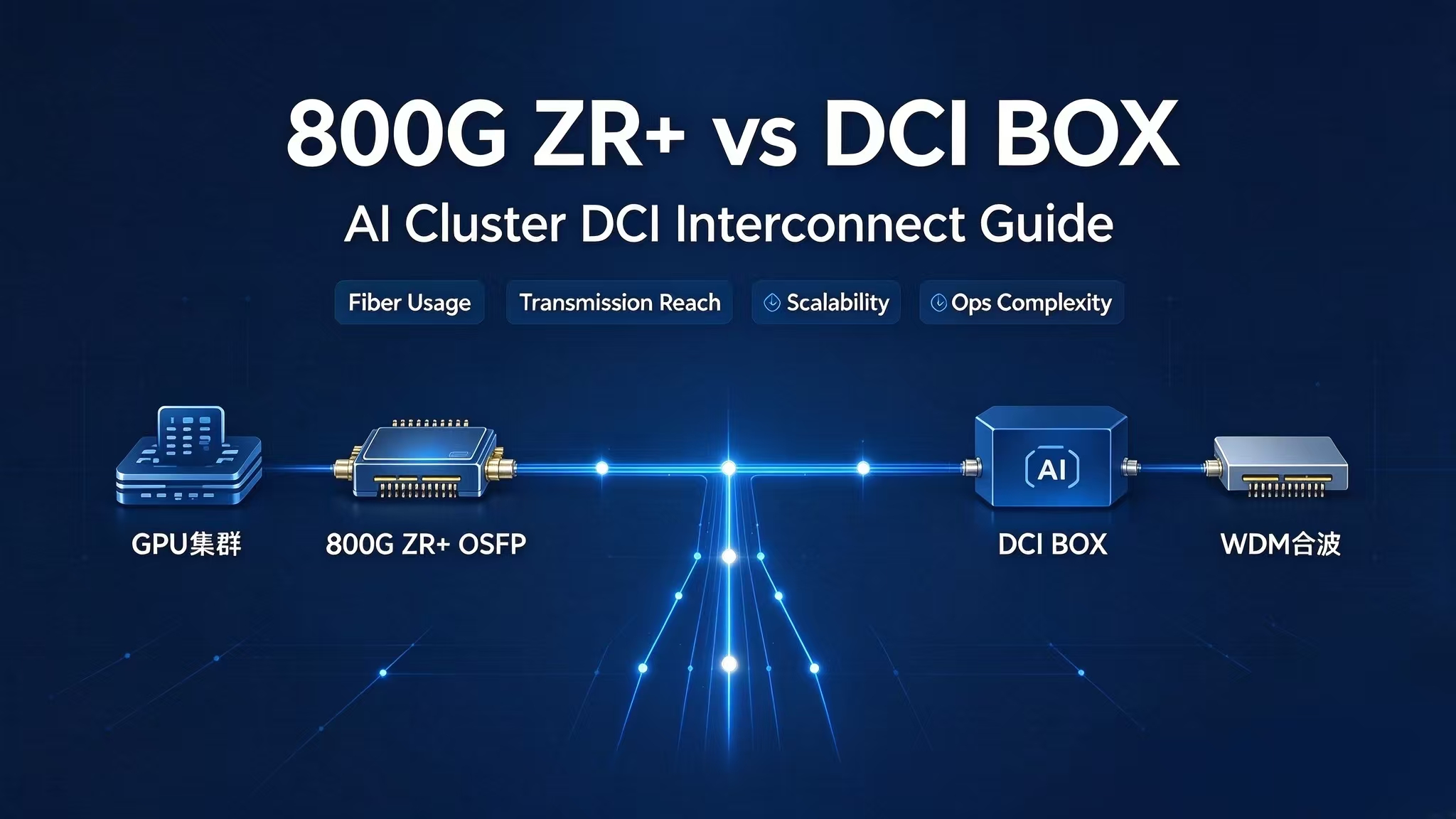
How to select DCI interconnects for multi-campus AI GPU clusters? This article compares the 800G ZR+ coherent direct-drive approach against the DCI BOX WDM approach across fiber resources, distance, cost, operations and scalability.
Facing a fiber shortage? Learn why traditional Grey Optics is costly and how DCI BOX solves fiber bottlenecks with lightweight WDM architecture
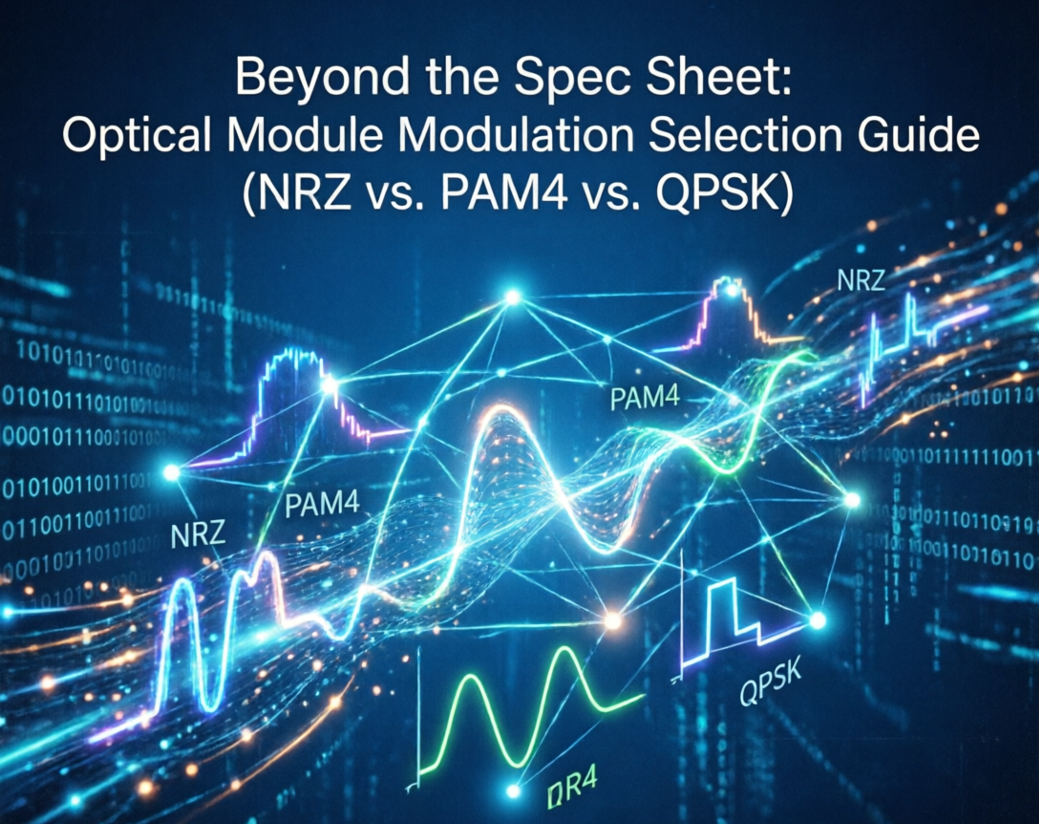
Balancing data rate, transmission distance, and cost remains a critical challenge in optical network design. This guide provides a comprehensive comparison of three dominant modulation formats: NRZ, PAM4, and QPSK. By analyzing their underlying mechanisms and performance metrics, we identify distinct application scenarios for each technology. The analysis reveals that while NRZ offers a cost-effective solution for short-reach interconnects, PAM4 has become the standard for high-speed data centers by doubling bandwidth efficiency. Conversely, QPSK dominates long-haul backbone networks due to its superior noise immunity. This article aims to equip network architects with the insights needed to select the optimal modulation strategy for specific link requirements.
A comprehensive comparison of CWDM and DWDM multiplexing across wavelength, channel spacing, distance, cost and applications to guide your selection.
An in-depth comparison of the 400ZR and OpenZR+ coherent standards — modulation, reach, interoperability and use cases.
A practical guide to optical link budget calculation: Tx power, Rx sensitivity, fiber loss, connector loss, amplifier gain and power margin.
Comparing the two leading 800G form factors — QSFP-DD and OSFP — on density, power, thermal design and ecosystem maturity.
Architecture, cost and O&M differences between passive WDM and active WDM (OTN), and how to choose by scenario.