
Target Audience
Network engineers and procurement managers deciding on modulation formats or fiber types.
Core Strategy
Translate complex technical parameters (NRZ/PAM4/QPSK) into the "distance vs. cost trade-off," helping customers make informed decisions and reflecting the value of consultative selling.
Topic
Beyond the Spec Sheet: A Practical Guide to Optical Module Modulation Selection (NRZ vs. PAM4 vs. QPSK)
Content
Introduction: The "Impossible Triangle" in Optical Communications
In optical network design, there is no perfect technology, only the most suitable trade-offs. When designing a link, you are essentially finding the balance point between Data Rate (Bandwidth), Transmission Distance, and Cost. Understanding the underlying modulation technologies is the key to solving this balancing puzzle. Below is a comparison of how the three mainstream technologies perform in real-world scenarios:
NRZ (Non-Return-to-Zero): The Reliable Veteran
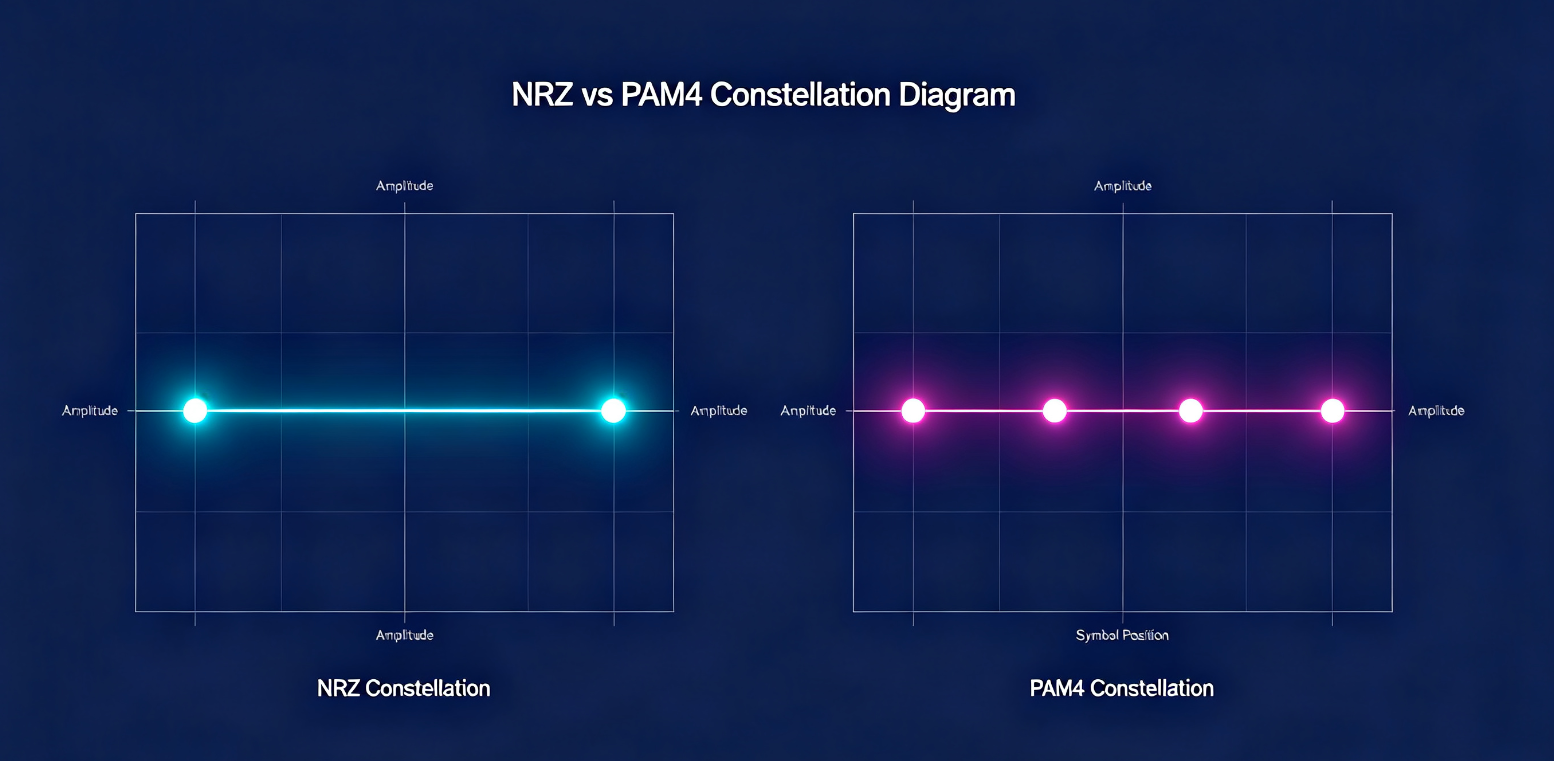
How it Works: The traditional binary method. One symbol represents 1 bit of information (0 or 1). It is like a simple switch—on or off.
Advantages: Extremely mature technology with low DSP (Digital Signal Processing) power consumption, resulting in the lowest module cost.
Limitations: As data rates increase (e.g., beyond 25G per lane), its noise immunity weakens, limiting the transmission distance.
Best Scenarios: Short-reach interconnects (e.g., intra-rack data center links, metro access within 10km) where ultimate cost-effectiveness is pursued.
PAM4 (Pulse Amplitude Modulation 4-level): The Bandwidth Multiplier
How it Works: Introduces 4 voltage levels (00, 01, 10, 11). One symbol represents 2 bits of information. This effectively doubles the data rate at the same baud rate. Advantages: Easily achieves high data rates of 100G/400G/800G without increasing the bandwidth pressure on the laser. Limitations: The signal is more complex and sensitive to noise. It must rely on high-performance DSP chips for error correction, resulting in slightly higher power consumption and cost.
Best Scenarios: Intra-data center interconnects (DR/FR/LR) and metro aggregation layers. This is currently the mainstream choice for high-speed optical modules.
QPSK (Quadrature Phase Shift Keying): The Long-Haul Champion
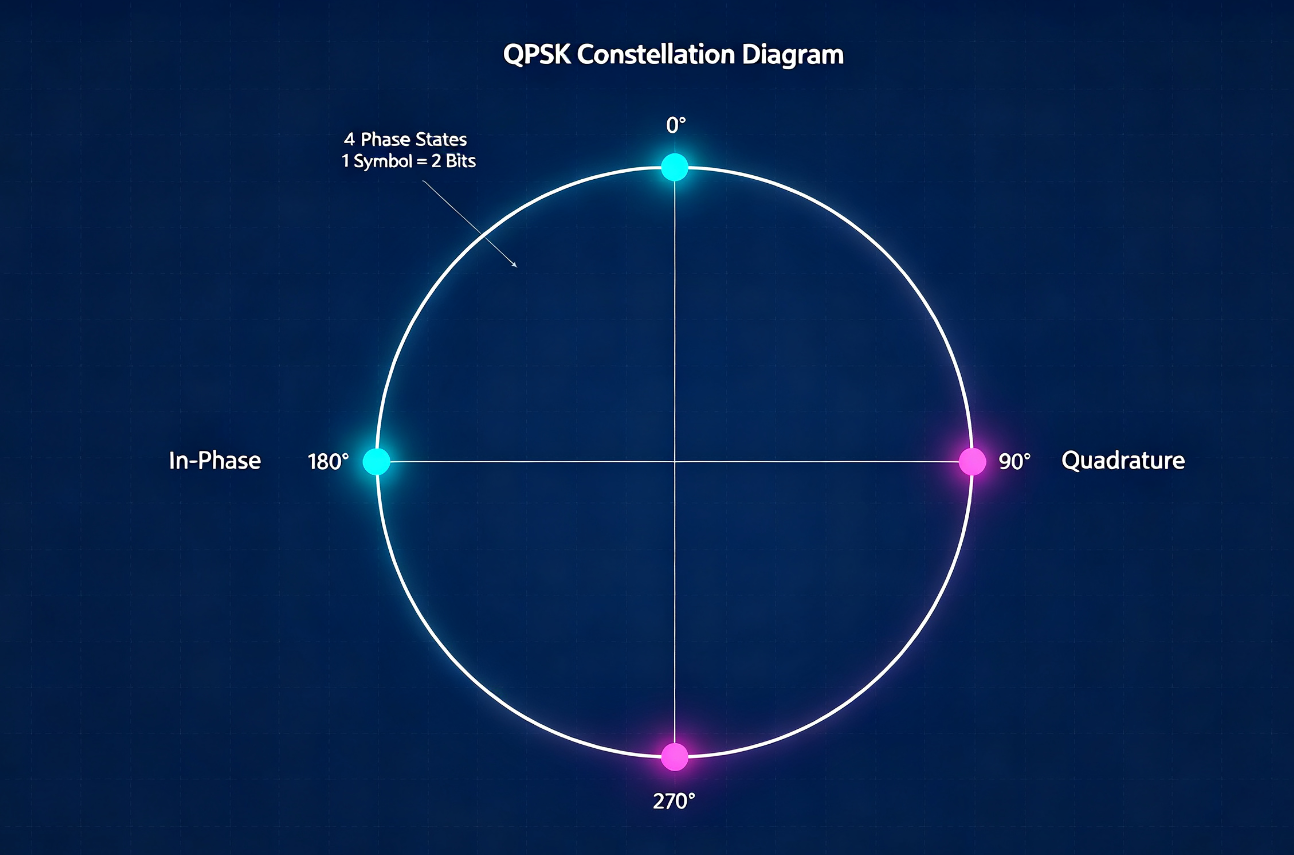
How it Works: Utilizes the phase and amplitude of light to carry information. It does not pursue the ultimate single-lane data rate but possesses extremely strong anti-interference capabilities.
Advantages: Exceptionally high sensitivity, capable of transmitting over vast distances (80km or even transoceanic spans) with excellent chromatic dispersion tolerance. Best Scenarios: Long-haul backbone networks, submarine cables, and ultra-long-reach metro core layers. Choose this when distance and stability are the absolute top priorities, regardless of cost.
💡 Selection Recommendations:
For short-reach and cost savings, choose NRZ.
For high-speed mainstream applications, choose PAM4.
For ultra-long-reach and rock-solid stability, choose QPSK.
What challenges is your network facing?
The evolution of optical communication technology is advancing rapidly, and there is no absolutely perfect solution—only the architecture that best fits your business needs. In your actual deployments, are you more inclined to use PAM4 or coherent optical technology? Or what tricky problems have you encountered in metropolitan area networks with limited fiber resources? Feel free to share your thoughts in the comments section below and discuss and exchange ideas with network engineers around the world!