
Regional IDC Metro Optical-Electrical Decoupling · 200G DP-QPSK
Project Background & Challenges
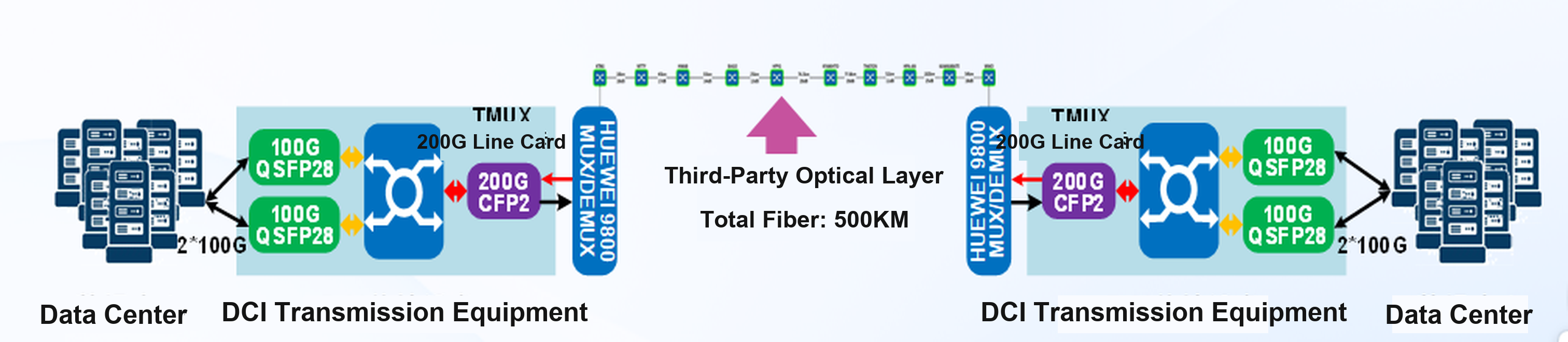
A regional IDC colocation provider operating two data centers in different locations had a metro transport network originally built on third-party equipment (Huawei, ZTE, etc.). Rapid business growth called for an additional 200G inter-center interconnect, but the customer did not want to replace the deployed optical-layer hardware and fiber links — the goal was to expand capacity while reusing the existing infrastructure.
The link totals 500 km and spans multiple optical amplifier sites; long-haul transmission placed stringent demands on OSNR margin and link error-correction capability, while the traffic cutover had to keep downtime to a minimum.
OTSLink Solution
OTSLink deployed 200G coherent single-wavelength electrical-layer boards in an optical-electrical decoupled architecture, carrying services transparently through the existing third-party optical layer without touching the incumbent optical amplifiers or fiber plant.
The design is based on DSP digital signal processing with 200G 75 GHz DP-QPSK modulation, and provides Ethernet packet statistics, LLDP, OSNR monitoring and pre-FEC bit error reporting as key link diagnostics.
The whole system is managed by the NetRiver unified NMS platform, which supports SNMP/NETCONF protocols and web-based B/S management for centralized, cross-vendor link monitoring and O&M.
Project Outcomes
The system has run stably since commissioning, with all indicators meeting the customer’s IDC SLA. By adding only OTSLink electrical-layer equipment and fully reusing the existing fiber and third-party optical layer, the customer cut CAPEX significantly, shortened the project schedule and achieved a smooth bandwidth upgrade with no large-scale service outage.
Need a multi-vendor DCI optical-electrical decoupling solution? Contact our transmission engineers for a custom design
IDC Enterprise Metro Network · 400G 16QAM · 16T per Fiber
Project Background & Challenges
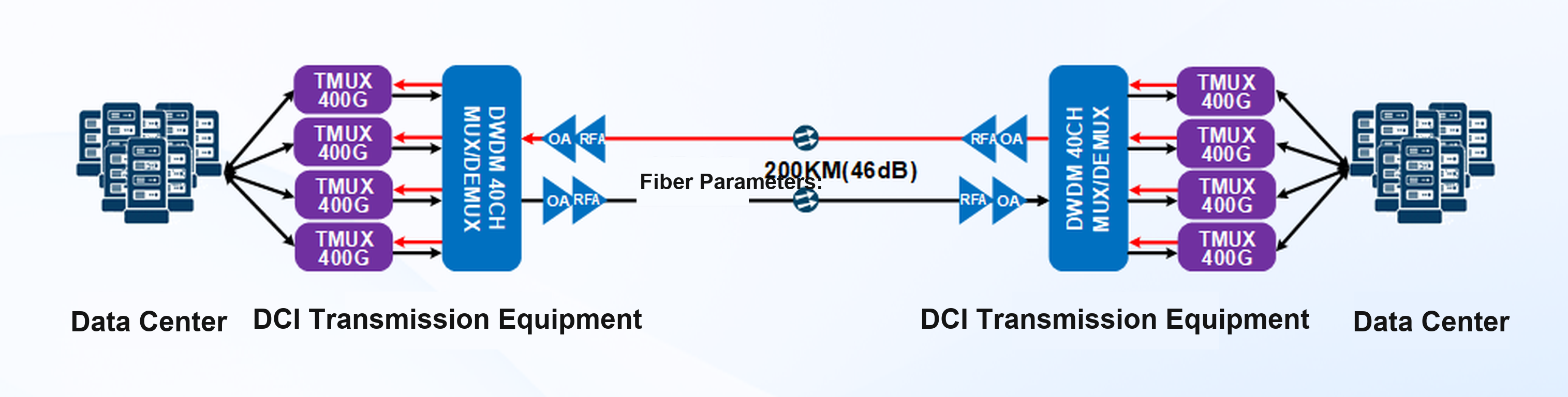
For an enterprise IDC provider, tenant traffic between its two data centers was growing fast and the existing link was nearing saturation. The customer needed a 200 km metro DCI link with a 46 dB link budget, maximizing per-fiber capacity on limited fiber resources to carry heavy 400G traffic while preserving long-haul OSNR margin and link stability.
OTSLink Solution
OTSLink delivered a 400G coherent DWDM metro transport solution based on DSP digital signal processing with 400G 75 GHz 16QAM modulation, reaching up to 16T of aggregate capacity per fiber.
The solution provides Ethernet packet statistics, LLDP, real-time OSNR monitoring and pre-FEC bit error analysis, managed end to end by the NetRiver unified NMS platform with SNMP/NETCONF support and a B/S web architecture for full link visualization.
Project Outcomes
The system has run stably since commissioning, with all transport indicators meeting the business SLA. By fully exploiting the bandwidth potential of each fiber, the design saves substantially on fiber procurement and construction costs and elastically supports continued tenant growth — meeting the high-density, high-bandwidth DCI needs of an enterprise IDC.
Want a high-bandwidth DCI solution that maximizes fiber utilization? Contact our transmission engineers for a tailored design
Carrier Cross-Sea Transport · 10GE/100GE/400GE Mixed-Rate Access
Project Background & Challenges
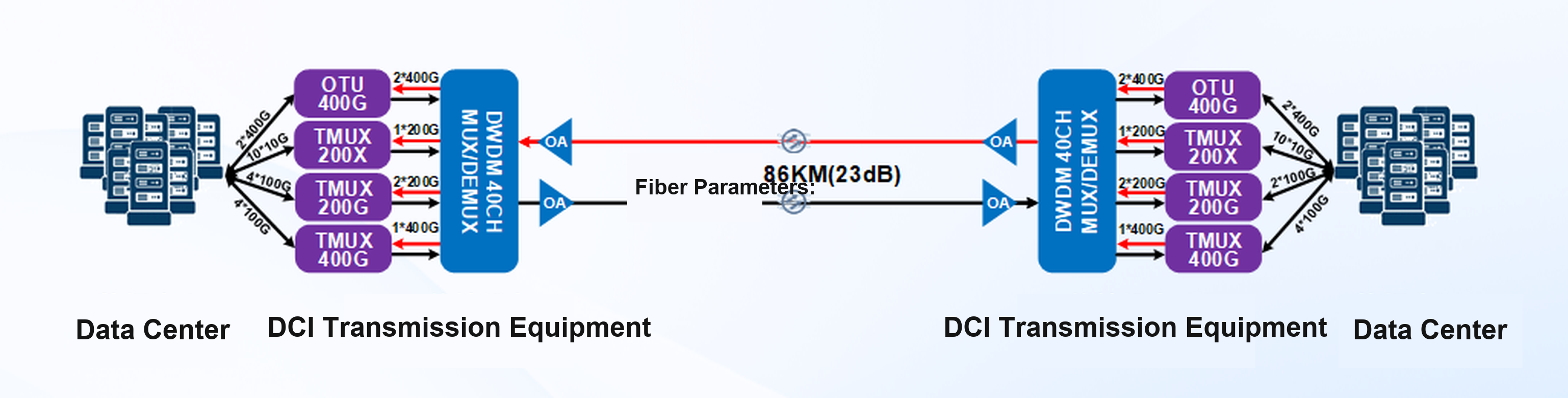
A regional carrier needed an 86 km cross-sea DCI link with a 23 dB link budget. Service access was complex, carrying 10GE, 100GE and 400GE mixed-rate traffic on the same system.
The cross-sea fiber environment is demanding on link stability, OSNR margin and mixed-service scheduling; the customer required a single transport platform that flexibly adapts to multiple Ethernet rates, allows smooth future expansion and provides complete link monitoring.
OTSLink Solution
OTSLink deployed a DWDM cross-sea transport system based on DSP digital signal processing, supporting multiple modulation formats — 400G 75 GHz 16QAM and 200G 50 GHz PCS-16QAM.
The platform natively supports mixed 10GE/100GE/400GE access and provides Ethernet packet statistics, LLDP, real-time OSNR monitoring and pre-FEC bit error analysis as link diagnostics.
The whole system is managed by the NetRiver unified NMS platform with SNMP/NETCONF support and a B/S web architecture, giving the carrier unified end-to-end visibility and remote monitoring of the cross-sea link.
Project Outcomes
The system has run stably since commissioning, with all transport indicators meeting carrier-grade SLA.
One platform handling multiple access rates reduces hardware stacking costs and simplifies the network; it reliably meets the harsh requirements of cross-sea transmission and flexibly scales bandwidth for the carrier’s diverse customer services.
Have cross-sea / long-haul mixed-rate DCI transport needs? Contact our transmission engineers for a tailored design
National Carrier Backbone · 400G Coherent Stepped Down to 200G QPSK
Project Background & Challenges
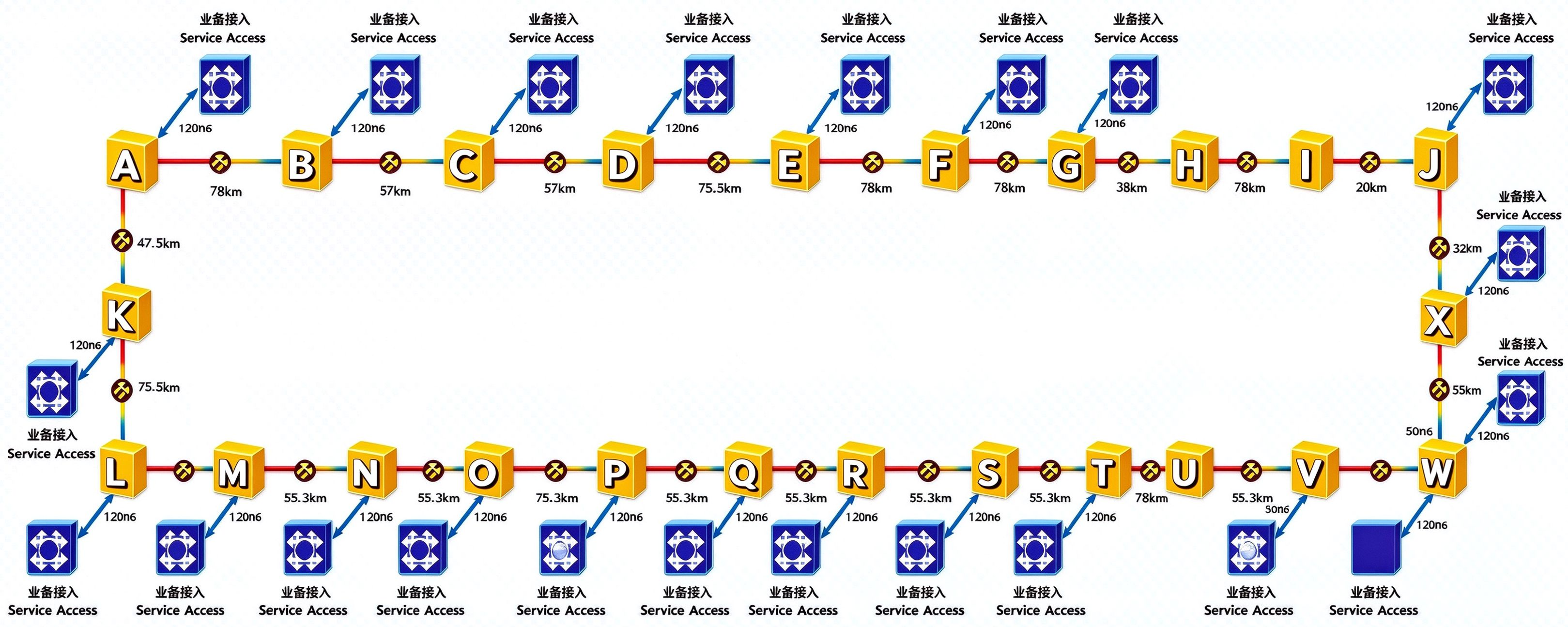
A national carrier built a nationwide ring backbone with many nodes and uneven span lengths; some fiber sections had high loss and tight OSNR margins. The customer wanted to use 400G coherent hardware, stepping down the modulation to extend reach and link tolerance, carry ultra-high capacity in a single fiber, and still get network-wide unified monitoring with flexible service add/drop at any node.
OTSLink Solution
OTSLink deployed a coherent DWDM backbone solution in which single-wavelength 400G coherent modules run stepped down to 200G DP-QPSK; based on DSP digital signal processing at 200G 75 GHz DP-QPSK, the line reaches up to 9.6T per fiber.
The solution provides Ethernet packet statistics, LLDP, real-time OSNR monitoring and pre-FEC bit error analysis; the NetRiver unified NMS platform manages the whole system over SNMP/NETCONF with a B/S web architecture for end-to-end visibility across the ring backbone.
Project Outcomes
The system has run stably since commissioning, with all transport indicators meeting the carrier’s backbone SLA.
Stepping 400G hardware down to 200G substantially improves OSNR margin on long spans and extends reach; without changing the hardware platform, it combines high capacity with link reliability and flexibly supports service scheduling and continued expansion across the network’s nodes.
Consulting on long-haul, multi-span, high-capacity backbone transmission? Talk to our transmission engineers
Carrier Backbone Transport Network · 400G 16QAM · 16T per Fiber
Project Background & Challenges
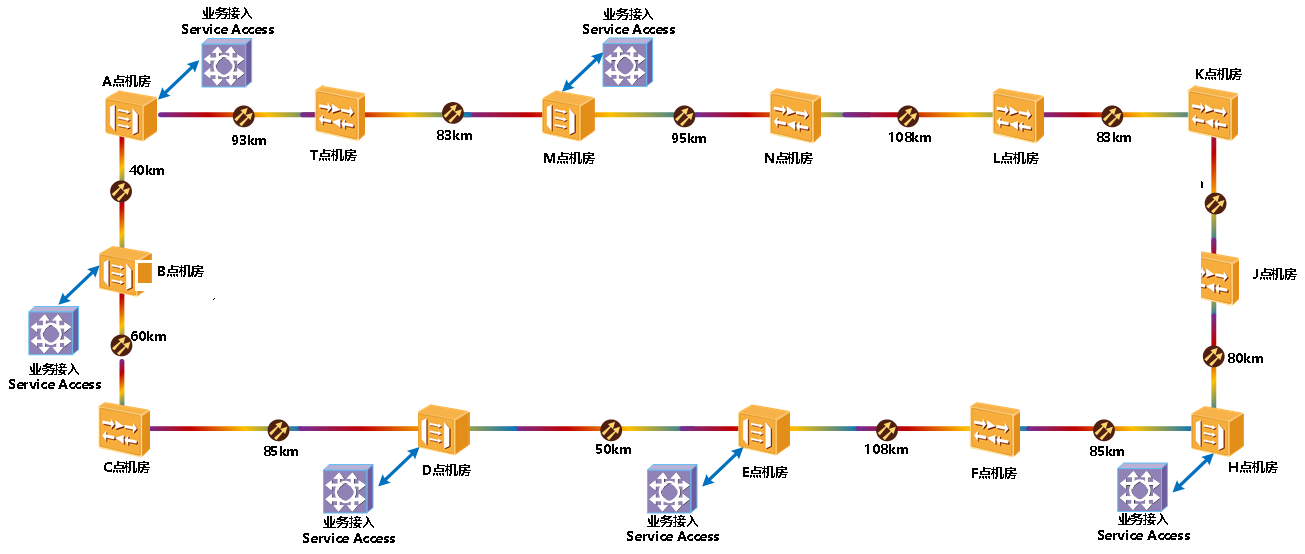
A carrier planned a core backbone about 1,100 km long, with multiple data-center nodes in series and uneven span lengths. High reliability was mandatory — 1+1 line protection against fiber cuts — along with flexible point-to-point service scheduling between nodes. The system is designed for 40 × 400G with six 400G waves activated initially and room to expand on demand, plus complete link monitoring and network-wide unified O&M.
OTSLink Solution
OTSLink equipment builds the backbone DWDM network with DSP digital signal processing, 400G 75 GHz 16QAM modulation and up to 16T per fiber.
Ethernet packet statistics, LLDP, real-time OSNR monitoring and pre-FEC bit error analysis provide the link diagnostics; the NetRiver unified NMS platform manages the system over SNMP/NETCONF with a B/S web architecture for network-wide, end-to-end visibility.
The network deploys 1+1 equipment and line protection that switches automatically on fiber cuts to keep services alive; any node on the network can carry point-to-point transmission with bandwidth scheduled dynamically per node. The system is rated 40 × 400G, with six 400G waves deployed initially and ample headroom for expansion.
Project Outcomes
The system has run stably since commissioning, with all indicators meeting the carrier’s backbone SLA.
The 1+1 protection greatly improves disaster tolerance and prevents outages from fiber cuts; any node can flexibly schedule bandwidth as demand shifts. With ample spare channels, the platform scales smoothly to the full 40 × 400G configuration, supporting the carrier’s long-term backbone growth.
Long-haul backbone DWDM with high capacity and reliable protection? Contact our transmission engineers for a tailored design
Metro Network & Fiber Capacity Expansion
For metro backbone projects with exhausted fiber, OTSLink deploys DWDM with OADM to multiply per-fiber capacity without new cable construction; EDFA amplification and DCM dispersion compensation protect power margin and eye quality over long spans, with each section's link budget verified by our engineers.
Carrier OTN Transport Systems
A private-network carrier built its transport platform on OTN cross-connect and muxponder equipment carrying multi-rate services; 100G/400G coherent modules (400ZR/OpenZR+) deliver high integration and low latency on long-haul routes, while OLP line protection switches traffic between redundant paths.
Enterprise Private Networks & Link Engineering
In financial and enterprise optical private networks, the OTSLink engineering team delivers end-to-end service from product selection, link budget analysis and compatibility testing to deployment and commissioning; 1G–400G SFP/QSFP transceivers and fiber cabling have passed interoperability validation in multi-vendor environments.
Explore our WDM mux/demux products, optical transceivers and DCI solutions, or contact us for selection advice and link budget support.