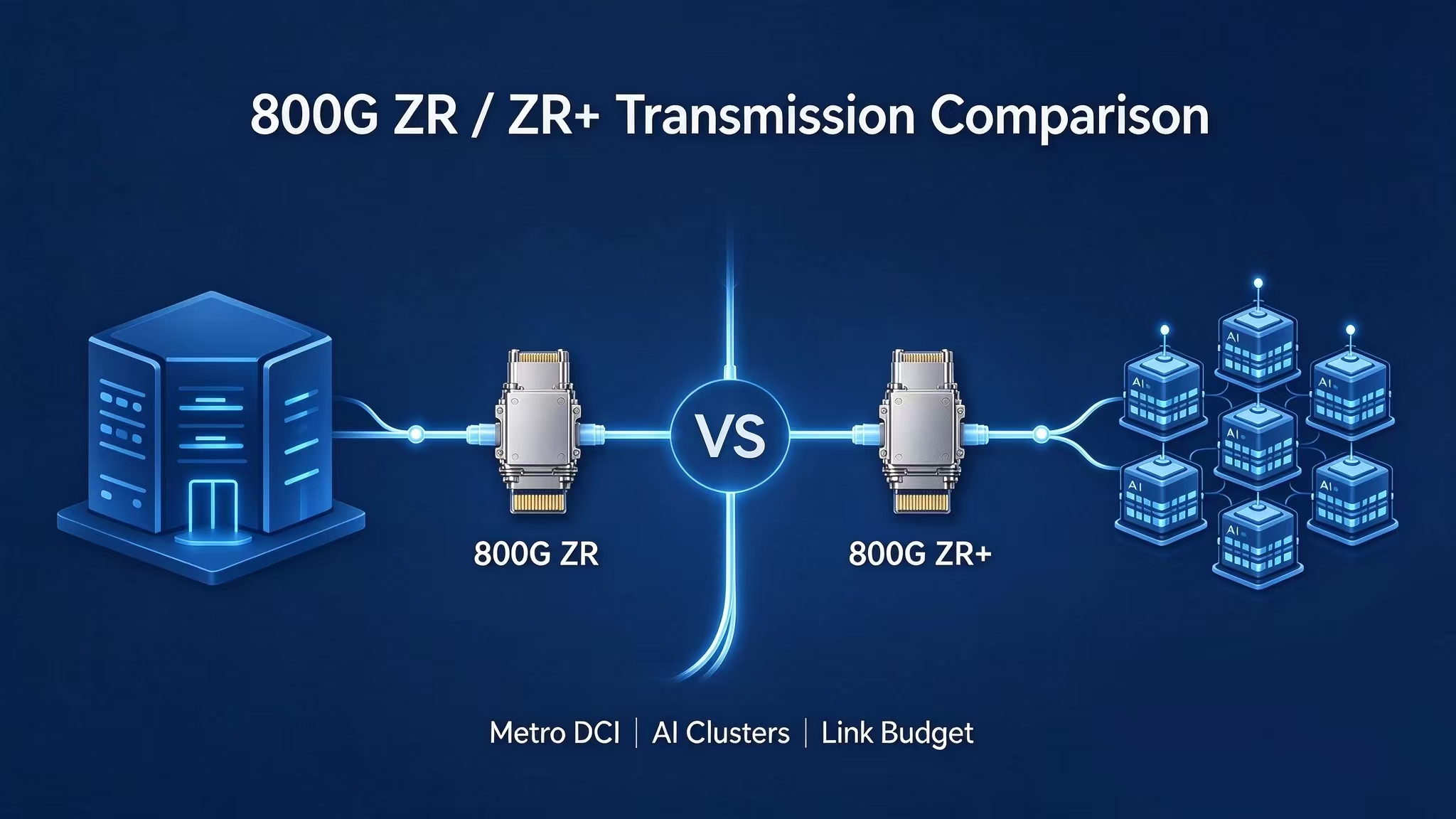
Goodbye to expensive DWDM equipment: how do 800G ZR/ZR+ coherent optical modules re-architect the DCI interconnect of AI compute clusters?
In 2026, AI compute has become the core battlefield that cloud providers and ISPs are fighting over. As NVIDIA H100/H200 and even next-generation GB30 racks roll out in dense deployments, compute architecture is shifting from "single-site concentration" toward "distributed cross region clusters".
Yet as compute scales out, a severe physical bottleneck is surfacing: the bandwidth-versus-cost imbalance of compute interconnects.
Traditional data center interconnect (DCI) relies on expensive DWDM transmission equipment and complex OTN electrical-layer grooming. For GPU clusters interconnecting across cities or campuses, must a full DWDM system be deployed for every single link? The arrival of 800G ZR/ZR+ digital coherent optical modules is changing that equation completely.
1. Pain points of AI compute DCI interconnects: why do traditional approaches fail the economics test?
In large-model AI training, both tensor parallelism and expert parallelism require extremely frequent, massive-scale data exchange between GPUs. In DCI scenarios, this high-bandwidth demand creates the following pain points:
Heavy upfront equipment investment: to carry 800G or 1.6T traffic, a traditional design must deploy a full stack of electrical-layer equipment (OTN) and optical-layer equipment (DWDM). This not only consumes expensive rack space but also drives CAPEX sharply higher.
Long delivery cycles: procurement, deployment and complex link commissioning of DWDM equipment usually take weeks or even months, an unacceptable time cost for AI compute rollouts where every second counts.
Power and space constraints: traditional DWDM systems consume enormous power. Under ever-tighter data center power budgets, every watt saved means room for more GPUs.
Against these pain points, plug-and-play 800G ZR/ZR+ coherent optical modules have become the optimal answer for AI compute cluster interconnects.
2. Deep dive: technical differences between 800G ZR and ZR+, and how to choose
Within the optical communications industry, 800G ZR and ZR+ both belong to the digital coherent module family, yet they differ subtly in real-world deployments. Specifying the wrong one can leave links unstable or budget wasted.
- 800G ZR coherent optical module: the cost-effective "value pick" for 80km cross-region interconnects
Transmission distance: a typical relay-free reach of 80km.
OSNR and optical margin: 800G ZR is optimized for medium-haul transmission and places relatively low demands on OSNR (optical signal-to-noise ratio). Even where link-budget margin is tight, 800G ZR keeps communications stable.
Power consumption: held around 25W-30W, making it well suited to high-density data center interconnects and easing rack cooling pressure.
Typical applications: cross-zone interconnects between same-city IDCs, opto-electrical decoupling for enterprise campuses within 80km, and 5G fronthaul aggregation.
- 800G ZR+ coherent optical module: the "performance beast" for 200km relay-free cross-region spans
Transmission distance: with enhanced DSP (digital signal processing) algorithms, relay-free reach extends up to 200km and even farther (400km+ with optical amplifiers).
OSNR and optical margin: the ZR+ module adopts more advanced soft-decision FEC (forward error correction) algorithms with stronger attenuation tolerance, but correspondingly imposes stricter OSNR requirements.
Power consumption: built on a higher-performance DSP chip with far greater processing power, 800G ZR+ typically lands between 35W-45W.
Typical applications: cross-city compute cluster interconnects, national backbone node interconnects, and cross-region connectivity between hyperscale AI compute campuses.
📊 Key specification comparison: 800G ZR vs 800G ZR+
| Key metric | 800G ZR coherent optical module | 800G ZR+ coherent optical module | Key difference |
| Transmission distance | ≤ 80km | ≤ 200km (or 400km+ with optical amps) | ZR+ delivers extreme cross-city transmission capability |
| DSP algorithm | Medium-complexity soft-decision FEC | High-order ultra soft-decision FEC | ZR+ brings stronger noise tolerance and error correction |
| Module power | Approx. 25W - 30W | Approx. 35W - 45W | ZR wins in low-power-density facilities |
| OSNR threshold | Relatively low, with better margin | Relatively high, demands cleaner links | ZR+ requires high fiber link cleanliness |
| Best-fit scenarios | Same-city IDC and enterprise campus interconnects | Cross-city compute hubs and national backbone interconnects | Select precisely by the actual span distance |
3. How do 800G ZR/ZR+ modules empower AI compute clusters? (real-world applications)
Scenario 1: low-latency interconnect of cross-city compute clusters
During the AI inference phase, traffic is often scattered across edge nodes. Deploying 800G ZR+ modules crosses the 150km physical distance directly to join AI inference clusters in two cities. Beyond eliminating the cost of traditional DWDM equipment, the optical-layer direct connection holds physical latency at the millisecond level, perfectly matching AI compute scheduling needs.
Scenario 2: lower-cost capacity expansion inside data centers (Scale-Up/Scale-Out)
As single switches evolve toward 51.2T and even higher bandwidth, inter-rack (Scale-Out) bandwidth demand is surging. Plugging 800G ZR modules straight into the switch faceplate delivers dense 800G transmission over a single fiber. Compared with conventional pluggable 800G DR/FR modules, the coherent approach can easily multiplex multiple wavelengths (WDM) onto one fiber when fiber resources are extremely tight, making the most of existing dark fiber.
4. Selection advice: how to choose the best DCI solution for your AI compute network?
When choosing between 800G ZR and ZR+ modules, pay close attention to the following core factors and avoid the pitfalls:
Measure the real link OSNR and dispersion: do not chase maximum reach blindly. If your actual span is within 50km, choosing 800G ZR+ is overkill, and DSP over-compensation adds unnecessary power and latency.
Compatibility and plug-and-play: AI compute clusters usually adopt multi-vendor mixed architectures. A quality 800G ZR/ZR+ module carries a programmable DSP that auto-adapts to mainstream vendor platforms (Cisco, Juniper, Arista, NVIDIA and others), enabling genuinely zero-touch deployment.
Compatibility and supply-chain stability: global 800G coherent module capacity is tightening, and lead times for upstream DSP chips and ITLA (integrated tunable laser assembly) parts are stretching. Choosing a partner with a stable supply chain and ample stock is critical.
Embrace lean DCI and build the next-generation AI compute foundation
At its core, AI compute interconnection pursues ultimate bandwidth density, the lowest physical latency and the best TCO (total cost of ownership). In a "lean, compact, high-performance" form, 800G ZR/ZR+ coherent optical modules match everything future AI data centers could ask of DCI interconnects.
Leave the bulky traditional transport equipment behind and light up your AI compute network directly with 800G coherent optical modules.
👉 Talk to an OTSLink expert: [email protected]