
- Why Does Module Selection Matter for Metro and Backbone Networks?
For operators and ISPs, bandwidth demands in metro and backbone networks are growing at double-digit rates annually. Optical transceivers are no longer mere connectivity components; they are the core determinants of network architecture complexity and Total Cost of Ownership (TCO). For long-haul transmission scenarios, selection must prioritize:
chromatic dispersion tolerance, the application of coherent technology, and unamplified long-reach capabilities.- Rate and Reach Evolution Roadmap
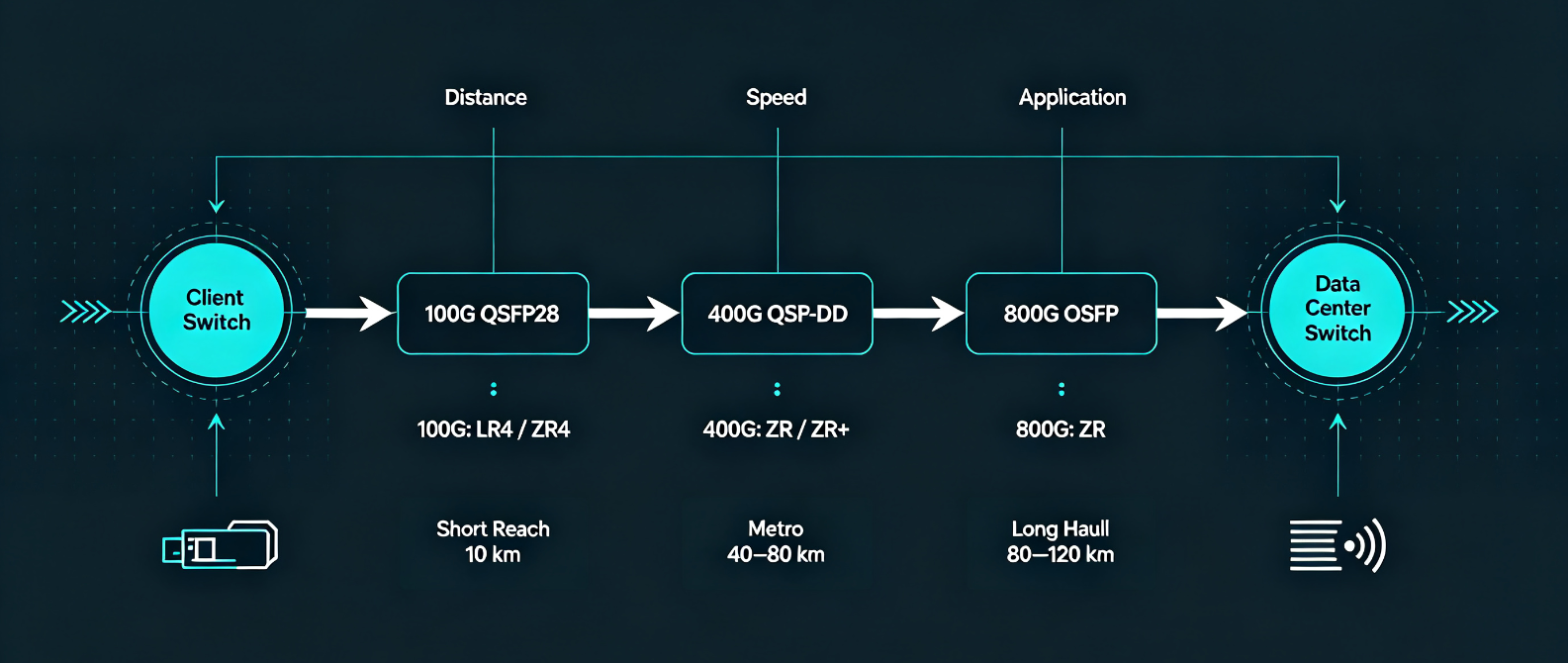
100G (QSFP28 / CFP2): The current workhorse for metro aggregation and access layers.Procurement Advice:
Standard LR4 is sufficient for metro access within 10km. For cross-region interconnects spanning 40km to 80km, it is highly recommended to adopt
100G ZR4 (O-band) or 100G Coherent modules.This eliminates the need for intermediate electrical regenerators, significantly reducing facility leasing and OPEX costs.
400G (QSFP-DD / OSFP): The primary choice for current DCI backbone upgrades.Procurement Advice:
For metro DCI links ranging from 80km to 120km, 400G ZR/ZR+ (Coherent Technology) is strongly recommended. Its built-in high-performance DSP perfectly overcomes long-haul fiber dispersion and attenuation, enabling true "plug-and-play" ultra-long-reach transmission.
800G (OSFP / QSFP-DD): Designed for next-generation AI computing clusters and core backbone networks.Procurement Advice:
Focus heavily on 800G ZR modules. With the explosive growth of AI training data volumes, 800G ZR will become the ultimate enabler for cross-city "single-hop" data center interconnects. Additionally, consider the superior thermal dissipation advantages of the OSFP form factor under extreme power consumption conditions.
- Backbone Module Procurement Checklist
Coherent vs. Direct Detection:
For long-haul links exceeding 40km, does the module utilize coherent optics to guarantee Bit Error Rate (BER)?
FEC Mechanism:Does it support SD-FEC (Soft-Decision Forward Error Correction) or Open FEC? This is critical for the stability of long-haul optical links.
Power Consumption & Thermal Management: 400G/800G coherent modules typically consume over 15W-20W. Ensure that the thermal design of your existing switches or DCI platforms meets the requirements.
Multi-Vendor Compatibility:Backbone networks typically consist of equipment from multiple vendors. Modules must undergo rigorous interoperability testing and support custom brand coding.
 Next Step
Submit your network parameters (distance, rate, number of optical fiber cores, device model), and the OTSLink engineering team will provide a customized solution and quotation.