
Target Audience:
Building flexible and open DCI WDM networks, replacing traditional closed "black box" equipment, and solving fiber exhaustion.
Core Products:
100G/400G DCI BOX / Open Line System (OLS)
Why Do ISPs and Integrators Need Open DCI Equipment?
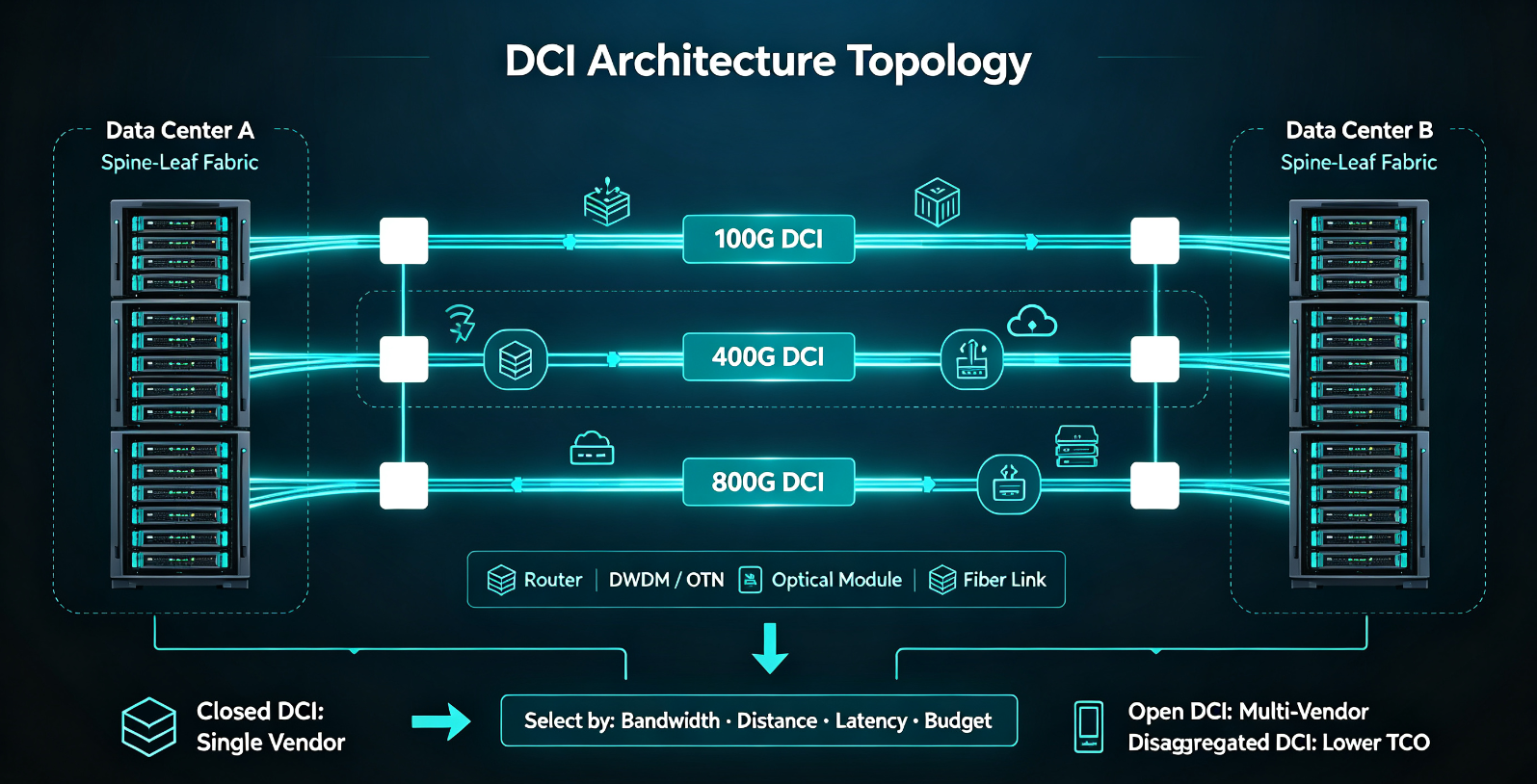
Traditional telecom-grade OTN equipment is stable but often "big and bulky," with tightly coupled hardware and software that makes scaling incredibly expensive. Open DCI transport systems decouple the optical layer from the electrical layer, purpose-built for the high-bandwidth, low-latency demands of data centers.
Value for Operators/ISPs: Drastically reduces the cost-per-bit. Breaks single-vendor lock-in through white-box or disaggregated architectures.
Value for Computing Customers: Provides a transparent optical pipeline supporting lossless transmission of any protocol (Ethernet, Storage FC, etc.), enabling minute-level agile service provisioning.
100G vs. 400G DCI Equipment Selection Strategy
100G DCI System:
Application: Existing metro aggregation rings, seamless upgrades for legacy sites.
Technology: Supports PAM4 DWDM or Coherent.
Architecture: Compact 1U/2U chassis, supporting multi-100G aggregation.
400G DCI System:
Application: New core DCI backbones, cross-region AI computing interconnects.
Technology: Supports 400ZR / OpenZR+ Coherent.
Architecture: Modular design, supporting integrated or separated optical/electrical deployment.
Decision Advice:
If existing fiber resources are severely exhausted, prioritize 400G DCI to maximize single-fiber capacity. 400G DCI utilizes C+L bands more efficiently, enabling massive-capacity long-haul transmission.
Choose "All-in-One" or pluggable architecture based on rack space and future scaling plans.
"Pitfall Avoidance" Points for DCI Procurement
True Openness: Verify if the equipment supports OpenZR+ or TIP (Telecom Infra Project) standards. This dictates whether you can freely swap coherent optical modules or optical amplifiers from different vendors in the future.
Optical Layer Enhancement: For metro long-haul scenarios, check if the DCI chassis has built-in or supports high-gain EDFA (Erbium-Doped Fiber Amplifier) and TDCM (Tunable Dispersion Compensation Module). This is the key to extending unamplified reach.
Automated Operations: Hardware is just the body; the soul lies in the control software. Ask if the vendor provides a visual Network Management System (NMS) and RESTful APIs to integrate with your existing SDN controllers for automated provisioning.
BiDi Support: If facing severe fiber exhaustion, prioritize DCI equipment supporting BiDi (Bidirectional) technology. It delivers massive two-way capacity over a single fiber strand, cutting fiber lease costs by 50%
Next Step
Submit your network parameters (distance, rate, number of optical fiber cores, device model), and the OTSLink engineering team will provide a customized solution and quotation.