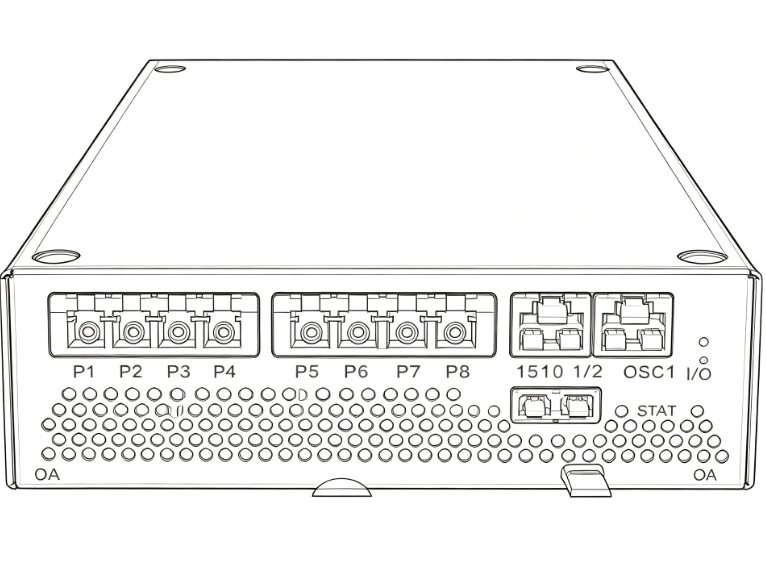
The "Eyes" and "Nerves" of the DWDM System: OSC Service Channel, Inline OTDR and Optical Channel Monitoring (OCM)
Designed for the visibility and operability of DWDM transport systems. OTSLink provides a full series of inline monitoring and auxiliary modules, covering three product lines: the OTS-OSC optical supervisory channel, OTS-OTDR-8CH intelligent inline optical time-domain reflectometry, and OTS-OCM optical channel monitoring. All modules undergo wavelength accuracy, dynamic range and long-duration stability testing, putting the health of every fiber link firmly under control.
How to choose among the three monitoring modules?
Module Type OTS-OSC Optical Supervisory Channel OTS-OTDR-8CH Inline Monitoring OTS-OCM Optical Channel Monitor Core Positioning The "nerve center" of system management and alarms (Service Channel) The "radar" for fiber fault location (Fault Locator) The "dashboard" of wavelength-level performance (Performance Monitor) Working Principle A dedicated service wavelength carries management frames, alarms and communication overhead (DCC). 1625nm out-of-band optical time-domain reflectometry scans fiber link events in real time without occupying service wavelengths. A built-in tunable filter samples optical power and OSNR wavelength by wavelength. Typical Applications Transport NMS coordination / alarm reporting
Carries ESC/DCC overhead, unifying NE management and orderwire. Fiber break / bend / splice-degradation location
8 channels per module, 42dB dynamic range, meter-level fault localization. Real-time per-wavelength power / OSNR patrol
Capacity-upgrade assessment, performance baselines and degradation trending. Key Advantages Standard overhead frame formats, compatible with mainstream transport NMS, zero-intrusion deployment. Out-of-band monitoring with no service impact, replacing manual OTDR truck rolls. Wavelength-level visibility, from a "black-box link" to "transparent O&M".
Critical Technical Criteria for Inline Monitoring Selection
Pain point: Optical power drift and OSNR degradation are invisible to the naked eye; by the time service is affected, the best response window has usually passed.
Recommendation: Choose a wavelength-level precision OCM that supports real-time per-wavelength power and OSNR collection, and establish performance baselines with degradation-trend alarms.
Pain point: With insufficient dynamic range, far-end splices and micro-bend events drown in noise, and inaccurate localization slows repairs.
Recommendation: An inline OTDR should offer ≥42dB dynamic range and meter-level event resolution; the 1625nm out-of-band wavelength is fully isolated from service signals, covering even long-haul spans end to end.
Pain point: Monitoring link by link with separate devices, with multi-vendor NMS islands, fragments the O&M view.
Recommendation: Prefer consolidated multi-channel form factors (e.g. an 8-channel OTDR in one module), and use the OSC service channel to carry DCC/ESC management frames, converging alarms, orderwire and NE management.
From "reactive repair" to "proactive O&M", keeping the optical layer always on
Customer Concerns OTSLink Solutions "Optical degradation is silent — by the time an alarm fires, it's too late" 7×24 inline patrol: the OCM collects per-wavelength power and OSNR, and with performance baselines outputs degradation trends to warn of potential risks in advance. "Fiber-break localization relies entirely on manual OTDR truck rolls, and the repair window keeps slipping" Always-on inline OTDR: real-time 1625nm out-of-band scanning localizes faults to the meter, dispatching work orders to the exact spot and dramatically shortening MTTR. "Multi-vendor NMS information islands, inconsistent alarm semantics" Unified OSC service channel: standard DCC/ESC frame formats converge management, alarms and orderwire, giving a single view across network elements.
Typical Application Scenarios and Configuration Recommendations (Use Cases)
Metro DCI interconnects
Recommended configuration: OTS-OCM + OTS-OSC
Value: Wavelength-level performance visibility on top of a unified management service channel — full wave-channel health without instrument patrols, making unattended sites possible.
Long-haul backbone and inter-regional trunks
Recommended configuration: OTS-OTDR-8CH + OTS-OCM
Value: Out-of-band OTDR covers long spans end to end, with 42dB dynamic range pinpointing far-end events; the OCM tracks OSNR evolution across amplifier chains, working with the optical amplification scheme to safeguard transmission margin.
Multi-wavelength capacity upgrades and managed O&M
Recommended configuration: OTS-OCM (wavelength-level performance baseline)
Value: Before/after per-wavelength power comparison at a glance, with new wavelengths monitored from day one; in managed-O&M scenarios, deliver quantifiable link-health monthly reports to your customers.
Sample Trial & Support
Optical-layer visibility, validated with data
Inline monitoring is the basis of O&M decisions. OTSLink supports rigorous sample validation:
Factory test reports: every sample ships with measured reports covering wavelength accuracy, dynamic range, OSNR measurement accuracy and other key metrics.
Link monitoring planning: free advice on monitoring points and channel capacity planning, matching coverage precisely to your network scale.
Custom parameter configuration: OSC overhead protocol adaptation (DCC/ESC) and alarm reporting formats tailored to your management system.

OTS-OTDR-8CH in-line monitoring — 1625nm out-of-band, 8 channels per module, 42dB precise fault location.